AN-03: Atmospheric Attenuation
Hardware Required: None
Software Required: MATLAB, MATLAB Satellite Communications Toolbox
DOWNLOAD: All Plots, Matlab Code, STK Scenarios
This application note shows how to estimate atmospheric attenuation due to atmospheric gases, cloud cover and rain in a space to ground RF link using MATLAB's Satellite Communications Toolbox and the ITU-R P.618 model. Examples of computed attenuation curves are provided for Stockholm, Washington DC, Cairo, and Brazilian Amazonas.
The losses shown in the plots are applicable for any type of satellite: Low Earth Orbit (LEO), Geostationary (GEO) and High Earth Orbit (HEO) since any additional attenuation beyond the Earth's atmosphere is governed by free space path loss. The plots shown in this application note only include atmospheric effects. Consequently, the end user is responsible for adding in free space path loss, tropospheric scintillation, RF subsystem losses, and communications system link requirements.
CONTENTS
1. Summary
When estimating an RF link for a satellite communications system it may be necessary to consider environmental effects on that link. At higher frequencies (above 10 GHz) losses due to clouds or rain can be significant, especially at shallow user elevation angles. This application note is intended to be a starting point for estimating atmospheric losses by providing plots for individual contributors (atmospheric gases, cloud, and rain) as well as a 'rollups' where components are summed to define weather conditions (clear sky, cloudy, light rain, heavy rain).
MATLAB code is provided that can be customized to model a specific location and to tweak the numerous assumptions that need to be carefully mapped to measurements of a specific ground site. For rough estimates, plots are provided with generalized assumptions for a diverse set of locations around the World.
2. DATA
Attenuation plots were generated for the following locations: Stockholm, Washington DC, Cairo, and the Brazilian state of Amazonas. These plots can be re-generated or generated for an entirely different geographic location by downloading the MATLAB code associated with this application note. MATLAB Satellite Communications Toolbox is required to run the code. A free 30 day trial of the Satellite Communications Toolbox is available from Mathworks. The 3D satellite pass videos are not associated with the computed data directly; it is only a visual representation of the look geometry associated with the geographic location.
2.1 Data - Stockholm, Sweden
Some Text....
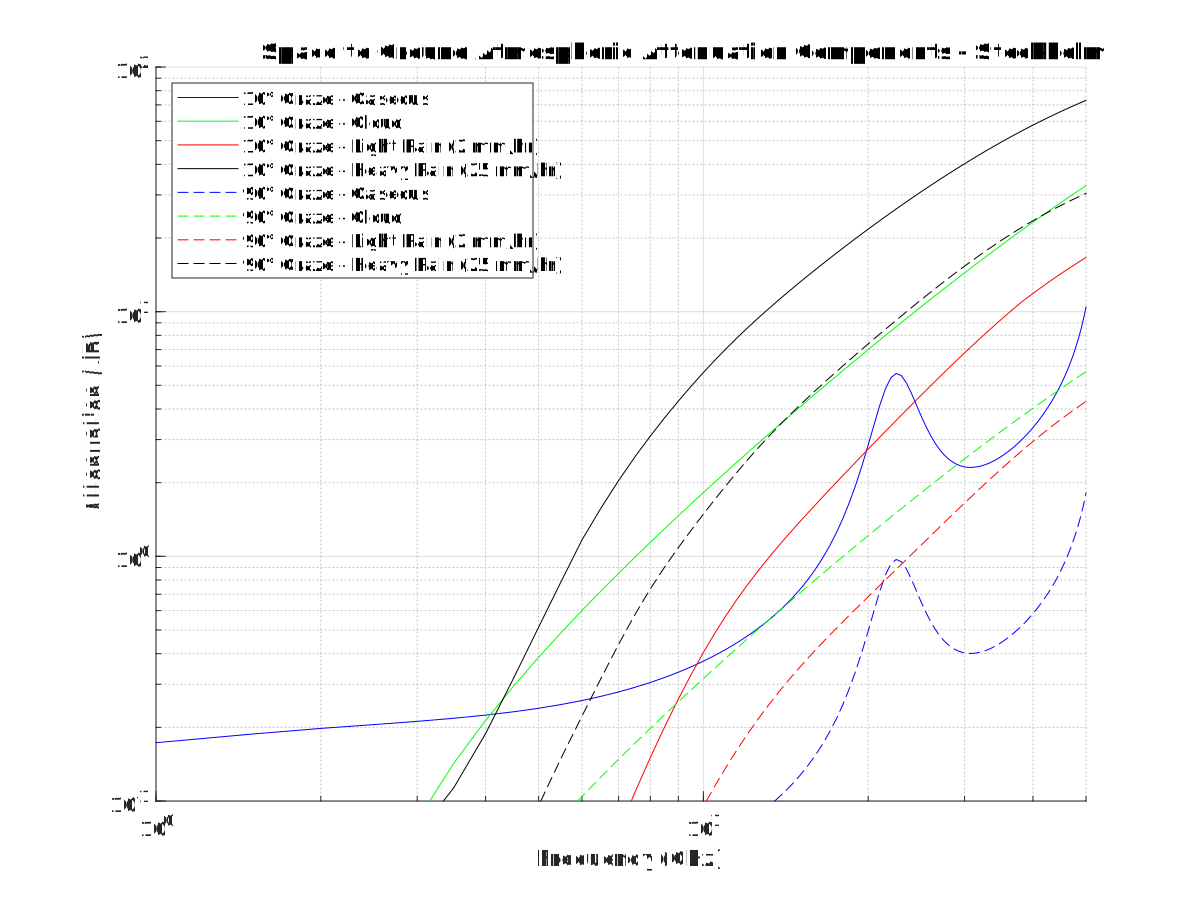
Figure 1. Individual Atmospheric Attenuation Contributors (svg, png)

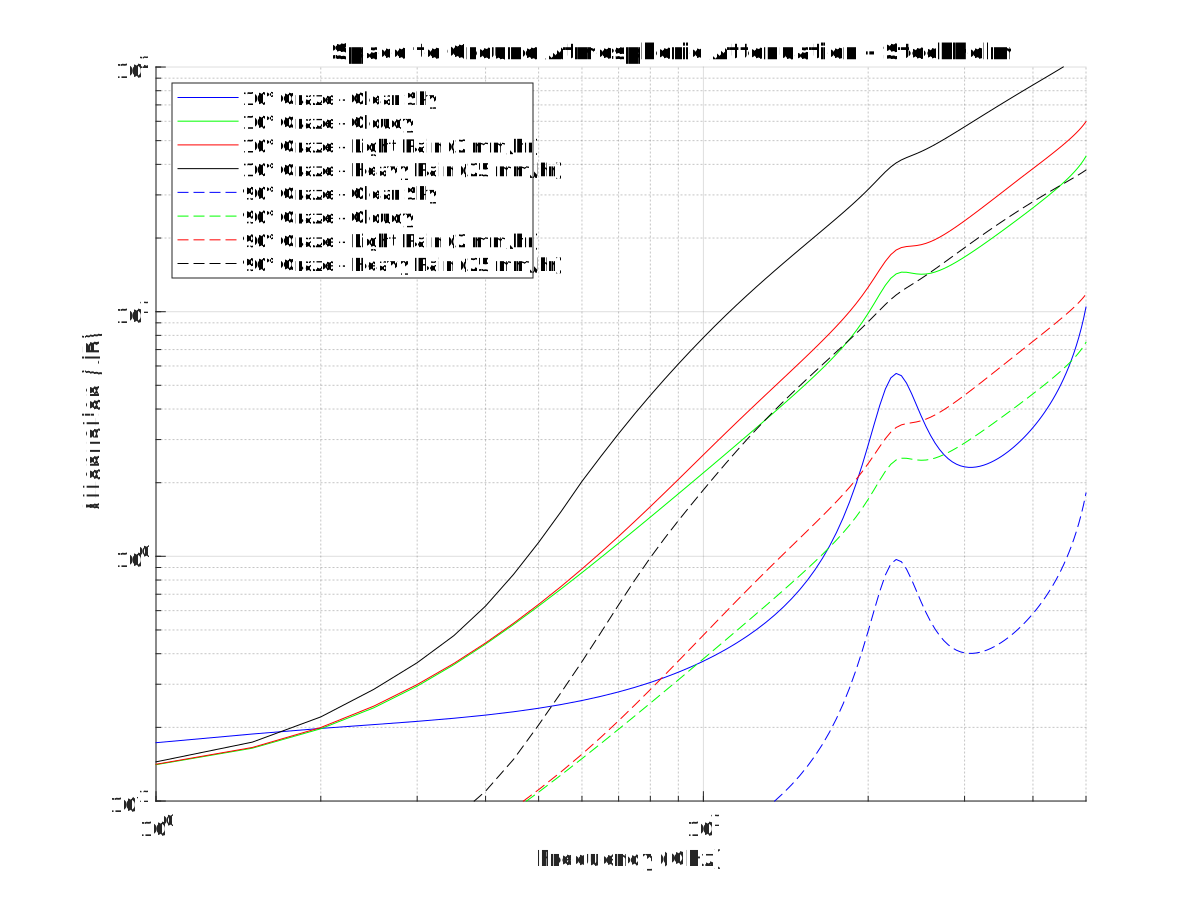
Figure 2. Rollup of Individual Atmospheric Attenuation Contributors.
'Cloudy' = gaseous + cloud. 'Rain' = gaseous + cloud + rain
(svg,
png)

Figure 3. STK Video Visualizing Link Geometry - Stockholm
2.2 Data - Washington DC, USA
Some Text....

Figure 4. Individual Atmospheric Attenuation Contributors (svg, png)


Figure 5. Rollup of Individual Atmospheric Attenuation Contributors.
'Cloudy' = gaseous + cloud. 'Rain' = gaseous + cloud + rain
(svg,
png)

2.3 Data - Cairo, Egypt
Some Text....

Figure 6. Individual Atmospheric Attenuation Contributors (svg, png)


Figure 7. Rollup of Individual Atmospheric Attenuation Contributors.
'Cloudy' = gaseous + cloud. 'Rain' = gaseous + cloud + rain
(svg,
png)

Figure 8. STK Video Visualizing Link Geometry - Cairo
2.4 Data - Amazonas, Brazil
Some Text....

Figure 9. Individual Atmospheric Attenuation Contributors (svg, png)


Figure 10. Rollup of Individual Atmospheric Attenuation Contributors.
'Cloudy' = gaseous + cloud. 'Rain' = gaseous + cloud + rain
(svg,
png)

Figure 11. STK Video Visualizing Link Geometry - Amazonas
3. General Conclusions
From the plots of these four varied locations on Earth, we can make a few general conclusions,
- Frequency < 5 GHz: Worst case 2 dB atmospheric attenuation in any weather
- Frequency < 10 GHz: Worst case 3 dB atmospheric attenuation unless heavy rain
- Elevation angle significantly impacts attenuation loss at high frequencies
4. Assumptions
The following assumptions were made for all plots in section 2. The values where chosen as a compromise of what is typical for a variety of geographic locations.
Surface Temperature = 273           kelvin
water Vapor Density = 10            g/m^3
Total Columnar Content = 3          cloud liquid Kg/m^2
Rain Annual Exceedance = 0.01
Total Annual Exceedance = 0.001

Notes:
Date Run: 15 APR 2024.
Tropospheric scintillation not factored in.